DeepSeek OCR 2: Automatically generating LaTeX from a complex document
The goal of this test was practical: to verify whether a complex PDF can be converted into a working LaTeX book file using DeepSeek OCR 2 locally, without external APIs.
The source document on maritime charters had dense structure: many headings and subheadings, a large number of links, and footnotes. The key question was not only text recognition, but whether structure and footnotes could be preserved in a format suitable for further editing and translation.
If you need to OCR complex documents locally (books, regulations, contract materials) and want a business-ready result rather than raw OCR output, you can send your task via the brief form.
What we tested
- Whether pages of a complex book can be recognized reliably in a local setup.
- Whether OCR outputs can be merged while preserving both structure and footnotes.
- Whether the final output can be a single LaTeX file ready for the next processing stage.
Result
The test was successful: a single final LaTeX file of the book was produced.
So the hypothesis was confirmed: for this document class, a usable LaTeX result can be obtained via a local OCR pipeline plus post-processing.
The next stage of the same project is automated translation of this LaTeX into Russian with Qwen 2.5 32B, including quality-gate and hybrid polishing: separate translation post.
Machine and resources
- Machine: MacBook Pro M1, 32 GB RAM.
- Execution: inside Docker, CPU mode.
- Inference mode:
cpu,float32,attn_impl=eager.
Performance from terminal logs
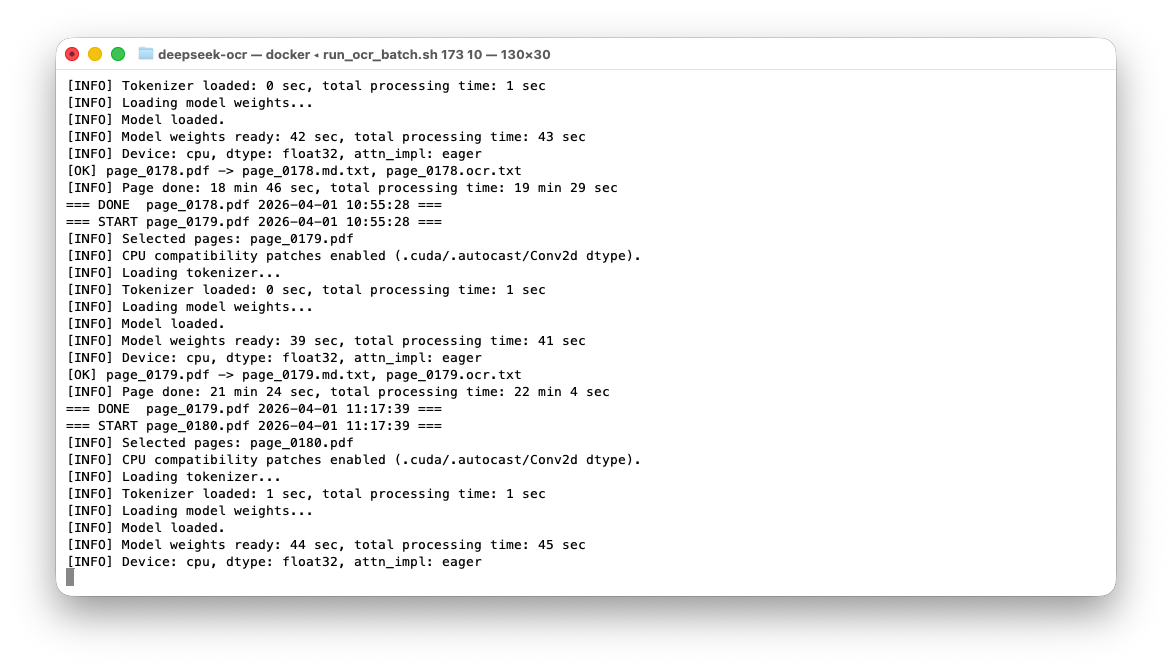
Here is what terminal execution looked like: in the attached log fragment for pages 0178 and 0179, processing one page took about 18-21 minutes, and model weight loading before processing took about 39-44 seconds.
Technical details
The document was processed page by page. Two OCR passes were used for each page:
-
structured pass (produces cleaner text hierarchy),
<image> <|grounding|> Convert the document to markdown. -
full OCR pass (better at extracting complete text, including footnotes),
<image>
Free OCR.
Then outputs were merged: structure came from the first pass, while footnotes and missing fragments were pulled from the second pass. After that, a single LaTeX file was assembled, along with a separate list of spots for manual review.
Model and exact revision: deepseek-ai/DeepSeek-OCR-2 @ aaa02f3811945a91062062994c5c4a3f4c0af2b0.
OCR output examples
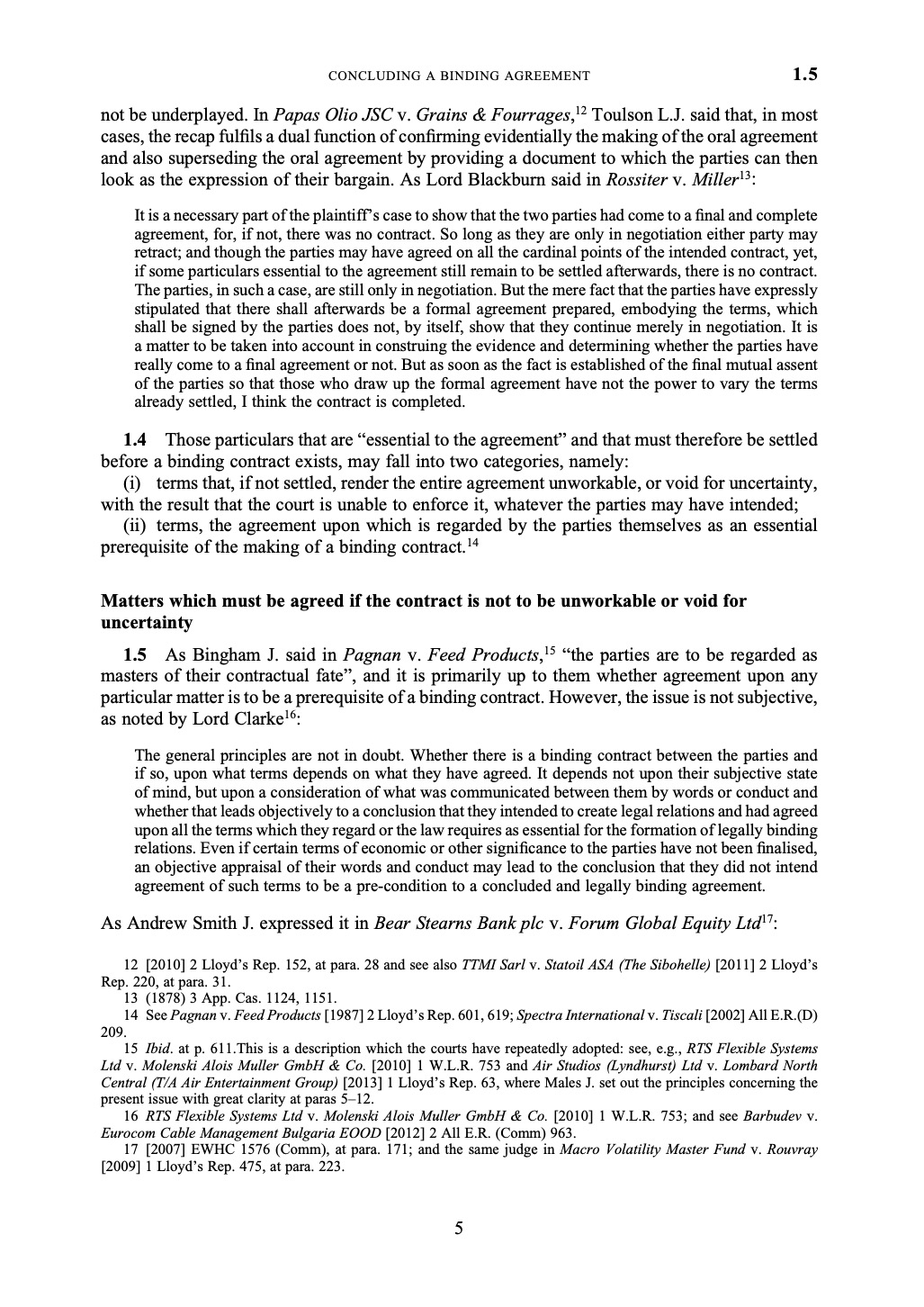
Below are two real fragments from one recognized page: a structured Markdown output and a full Free OCR output.
Markdown recognition example (expand)
Comment: this mode preserves document structure better (headings and sections), but some elements like footnotes can be lost or simplified.
<|ref|>text<|/ref|><|det|>[[102, 79, 887, 145]]<|/det|>
not be underplayed. In Papas Olio JSC v. Grains & Fourrages, \( ^{12} \)  Toulson L.J. said that, in most cases, the recap fulfils a dual function of confirming evidently the making of the oral agreement and also superseding the oral agreement by providing a document to which the parties can then look as the expression of their bargain. As Lord Blackburn said in Rossiter v. Miller \( ^{13} \) :
<|ref|>text<|/ref|><|det|>[[138, 156, 887, 315]]<|/det|>
It is a necessary part of the plaintiff’s case to show that the two parties had come to a final and complete agreement, for, if not, there was no contract. So long as they are only in negotiation either party may retract; and though the parties may have agreed on all the cardinal points of the intended contract, yet, if some particulars essential to the agreement still remain to be settled afterwards, there is no contract. The parties, in such a case, are still only in negotiation. But the mere fact that the parties have expressly stipulated that there shall afterwards be a formal agreement prepared, embodying the terms, which shall be signed by the parties does not, by itself, show that they continue merely in negotiation. It is a matter to be taken into account in construing the evidence and determining whether the parties have really come to a final agreement or not. But as soon as the fact is established of the final mutual assent of the parties so that those who draw up the formal agreement have not the power to vary the terms already settled, I think the contract is completed.
<|ref|>text<|/ref|><|det|>[[103, 327, 886, 360]]<|/det|>
1.4 Those particulars that are “essential to the agreement” and that must therefore be settled before a binding contract exists, may fall into two categories, namely:
<|ref|>text<|/ref|><|det|>[[103, 361, 885, 393]]<|/det|>
(i) terms that, if not settled, render the entire agreement unworkable, or void for uncertainty, with the result that the court is unable to enforce it, whatever the parties may have intended;
<|ref|>text<|/ref|><|det|>[[103, 394, 885, 427]]<|/det|>
(ii) terms, the agreement upon which is regarded by the parties themselves as an essential prerequisite of the making of a binding contract. \( ^{14} \)
<|ref|>sub_title<|/ref|><|det|>[[103, 450, 810, 483]]<|/det|>
## Matters which must be agreed if the contract is not to be unworkable or void for uncertainty
<|ref|>text<|/ref|><|det|>[[102, 491, 886, 557]]<|/det|>
1.5 As Bingham J. said in Pagnan v. Feed Products, \( ^{15} \)  “the parties are to be regarded as masters of their contractual fate”, and it is primarily up to them whether agreement upon any particular matter is to be a prerequisite of a binding contract. However, the issue is not subjective, as noted by Lord Clarke \( ^{16} \) :
<|ref|>text<|/ref|><|det|>[[137, 568, 887, 686]]<|/det|>
The general principles are not in doubt. Whether there is a binding contract between the parties and if so, upon what terms depends on what they have agreed. It depends not upon their subjective state of mind, but upon a consideration of what was communicated between them by words or conduct and whether that leads objectively to a conclusion that they intended to create legal relations and had agreed upon all the terms which they regard or the law requires as essential for the formation of legally binding relations. Even if certain terms of economic or other significance to the parties have not been finalised, an objective appraisal of their words and conduct may lead to the conclusion that they did not intend agreement of such terms to be a pre-condition to a concluded and legally binding agreement.
<|ref|>text<|/ref|><|det|>[[104, 697, 844, 714]]<|/det|>
As Andrew Smith J. expressed it in Bear Stearns Bank plc v. Forum Global Equity Ltd \( ^{17} \) :
<|ref|>text<|/ref|><|det|>[[103, 729, 885, 755]]<|/det|>
12 [2010] 2 Lloyd’s Rep. 152, at para. 28 and see also TTMI Sarl v. Statoil ASA (The Sibolelle) [2011] 2 Lloyd’s Rep. 220, at para. 31.
<|ref|>text<|/ref|><|det|>[[130, 755, 366, 768]]<|/det|>
13 (1878) 3 App. Cas. 1124, 1151.
<|ref|>text<|/ref|><|det|>[[103, 768, 885, 793]]<|/det|>
14 See Pagnan v. Feed Products [1987] 2 Lloyd’s Rep. 601, 619; Spectra International v. Tiscali [2002] All E.R.(D) 209.
<|ref|>text<|/ref|><|det|>[[103, 794, 886, 845]]<|/det|>
15 Ibid. at p. 611. This is a description which the courts have repeatedly adopted: see, e.g., RTS Flexible Systems Ltd v. Molenski Alois Muller GmbH & Co. [2010] 1 W.L.R. 753 and Air Studios (Lyndhurst) Ltd v. Lombard North Central (T/A Air Entertainment Group) [2013] 1 Lloyd’s Rep. 63, where Males J. set out the principles concerning the present issue with great clarity at paras 5–12.
<|ref|>text<|/ref|><|det|>[[103, 845, 885, 871]]<|/det|>
16 RTS Flexible Systems Ltd v. Molenski Alois Muller GmbH & Co. [2011] 1 W.L.R. 753; and see Barbudev v. Eurocom Cable Management Bulgaria EOOD [2012] 2 All E.R. (Comm) 963.
<|ref|>text<|/ref|><|det|>[[103, 871, 885, 897]]<|/det|>
17 [2007] EWHC 1576 (Comm), at para. 171; and the same judge in Macro Volatility Master Fund v. Rouvray [2009] 1 Lloyd’s Rep. 475, at para. 223.
Free OCR recognition example (expand)
Comment: this mode extracts full text better, including footnotes, but structure (heading/section hierarchy) is usually less clean.
not be underplayed. In Papas Olio JSC v. Grains & Fourrages,\(^{12}\) Toulson L.J. said that, in most cases, the recap fulfils a dual function of confirming evidentially the making of the oral agreement and also superseding the oral agreement by providing a document to which the parties can then look as the expression of their bargain. As Lord Blackburn said in Rossiter v. Miller\(^{13}\):
It is a necessary part of the plaintiff’s case to show that the two parties had come to a final and complete agreement, for, if not, there was no contract. So long as they are only in negotiation either party may retract; and though the parties may have agreed on all the cardinal points of the intended contract, yet, if some particulars essential to the agreement still remain to be settled afterwards, there is no contract. The parties, in such a case, are still only in negotiation. But the mere fact that the parties have expressly stipulated that there shall afterwards be a formal agreement prepared, embodying the terms, which shall be signed by the parties does not, by itself, show that they continue merely in negotiation. It is a matter to be taken into account in construing the evidence and determining whether the parties have really come to a final agreement or not. But as soon as the fact is established of the final mutual assent of the parties so that those who draw up the formal agreement have not the power to vary the terms already settled, I think the contract is completed.
1.4 Those particulars that are “essential to the agreement” and that must therefore be settled before a binding contract exists, may fall into two categories, namely:
(i) terms that, if not settled, render the entire agreement unworkable, or void for uncertainty, with the result that the court is unable to enforce it, whatever the parties may have intended;
(ii) terms, the agreement upon which is regarded by the parties themselves as an essential prerequisite of the making of a binding contract.\(^{14}\)
**Matters which must be agreed if the contract is not to be unworkable or void for uncertainty**
1.5 As Bingham J. said in *Pagnan v. Feed Products*,\(^{15}\) “the parties are to be regarded as masters of their contractual fate”, and it is primarily up to them whether agreement upon any particular matter is to be a prerequisite of a binding contract. However, the issue is not subjective, as noted by Lord Clarke\(^{16}\):
The general principles are not in doubt. Whether there is a binding contract between the parties and if so, upon what terms depends on what they have agreed. It depends not upon their subjective state of mind, but upon a consideration of what was communicated between them by words or conduct and whether that leads objectively to a conclusion that they intended to create legal relations and had agreed upon all the terms which they regard or the law requires as essential for the formation of legally binding relations. Even if certain terms of economic or other significance to the parties have not been finalised, an objective appraisal of their words and conduct may lead to the conclusion that they did not intend agreement of such terms to be a pre-condition to a concluded and legally binding agreement.
As Andrew Smith J. expressed it in *Bear Stearns Bank plc v. Forum Global Equity Ltd\(^{17}\)*:
12 [2010] 2 Lloyd’s Rep. 152, at para. 28 and see also *TTMI Sarl v. Statoil ASA (The Sibolelle)* [2011] 2 Lloyd’s Rep. 220, at para. 31.
13 (1878) 3 App. Cas. 1124, 1151.
14 See *Pagnan v. Feed Products* [1987] 2 Lloyd’s Rep. 601, 619; *Spectra International v. Tiscali* [2002] All E.R.(D) 209.
15 *Ibid.* at p. 611. This is a description which the courts have repeatedly adopted: see, e.g., *RTS Flexible Systems Ltd v. Molenski Alois Muller GmbH & Co.* [2010] 1 W.L.R. 753 and *Air Studios (Lyndhurst) Ltd v. Lombard North Central (T/A Air Entertainment Group)* [2013] 1 Lloyd’s Rep. 63, where Males J. set out the principles concerning the present issue with great clarity at paras 5–12.
16 *RTS Flexible Systems Ltd v. Molenski Alois Muller GmbH & Co.* [2009] 1 W.L.R. 753; and see *Barbudev v. Eurocom Cable Management Bulgaria EOOD* [2012] 2 All E.R. (Comm) 963.
17 [2007] EWHC 1576 (Comm), at para. 171; and the same judge in *Macro Volatility Master Fund v. Rouvray* [2009] 1 Lloyd’s Rep. 475, at para. 223.
- Attempts to improve output by experimenting with prompts did not produce a noticeable gain.
- In practice, only two modes were stable: “convert to markdown” and “Free OCR”.
- The best practical result came not from one “ideal” pass, but from merging these two outputs.
- The resulting LaTeX is suitable as a base for the next stage: manual proofreading and translation into Russian.